
Last updated: November 2026
A mortgage lead arrives in your CRM at 10:15 a.m. By lunchtime, no one has called. The assigned loan officer is busy with another borrower, and the system hasn’t alerted anyone else.
You paid to generate that inquiry, but now you’re at risk of losing it before you even got to start the conversation.
This is where mortgage lead follow-up can make or break your marketing investment. Mortgage lenders invest in advertising, SEO, purchased leads, and referral programs to keep their pipelines moving. But generating an inquiry is only the first step.
Without a reliable process, even your most qualified leads can disappear into the CRM.
Schedule a Discovery Session
Learn how to attract new leads and clients.
Quick answer: How can lenders improve mortgage lead conversion?
Mortgage lenders can improve lead conversion by responding promptly, assigning every inquiry to a responsible loan officer, tracking borrower progress in a CRM, and nurturing prospects who aren’t ready to apply.
Measuring contact rates, application conversions, and funded loans helps identify where existing marketing opportunities are being lost.
Before spending more on mortgage leads, request a Mortgage CRM and Lead Conversion Audit to discover where your current pipeline may be losing opportunities.
Why mortgage lenders lose opportunities after generating leads
You may know the cost of generating leads, but do you understand exactly what happens after those leads enter your system?
Three common operational problems can undermine mortgage lead conversion.
Slow response times
A borrower requests information about a mortgage, but no one follows up until the next afternoon.
By then, the borrower may have contacted another lender, scheduled an appointment, or moved on.
Slow responses don’t necessarily indicate poor loan officer performance. Often, the underlying problems involve delayed notifications, manual lead distribution, or unclear expectations.
Unclear lead ownership
A new inquiry arrives in the CRM, but nobody knows who is responsible for contacting it.
Maybe the lead was assigned to an unavailable loan officer, or two people assume the other is handling it. Without clear ownership, opportunities can remain untouched even when a lender has enough capacity to reach out.
Every lead needs a designated owner, documented activity, and a clear next action.
Premature abandonment
Not every mortgage prospect is ready to apply immediately.
Some borrowers are:
- Improving their credit
- Saving for a down payment
- Researching financing options before purchasing a home
Treating these prospects as lost opportunities after a few unsuccessful attempts undermines their potential future value.
The next step isn’t to relentlessly pursue them until they convert. You need a structured, permission-based follow-up process that considers each borrower’s circumstances.
Mortgage lead generation vs. mortgage lead conversion
- Mortgage lead generation attracts prospective borrowers.
- Mortgage lead conversion moves those prospects toward completed applications and funded loans.
Both contribute to growth, but they solve different problems.
| Lead generation | Lead conversion |
| Attracts prospective borrowers | Turns inquiries into lending opportunities |
| Measures traffic and inquiries | Measures contact, applications, and funded loans |
| Relies on advertising, SEO, and referrals | Relies on loan officers, CRM workflows, and nurturing |
| Focuses on acquisition costs | Focuses on conversion efficiency and acquisition ROI |
A lender can generate hundreds of inquiries and still struggle to grow production if only a small percentage receives effective follow-up.
This distinction also changes how lenders evaluate acquisition channels. As we explain in our guide to buying vs generating mortgage leads, the strongest acquisition strategy isn’t necessarily the one that produces the lowest cost per lead. Rather, it’s the strategy producing funded loans at a sustainable acquisition cost.
How a 1% conversion improvement can produce five additional loans
Consider a hypothetical mortgage lender generating 500 leads per month.
The acquisition budget remains unchanged, but better follow-up increases the percentage of leads that become funded loans.
| Metric | Current performance | Improved performance |
| Monthly leads | 500 | 500 |
| Funded-loan conversion | 2% | 3% |
| Funded loans | 10 | 15 |
| Additional funded loans | — | 5 |
| Acquisition spending | $25,000 | $25,000 |
| Acquisition cost per funded loan | $2,500 | $1,667 |
The result: Five additional funded loans from the same acquisition investment. That’s a 50% increase in funded-loan volume, driven by a one-percentage-point improvement in conversion.
Assuming a $3,000 contribution margin per funded loan before marketing costs, five additional loans would generate $15,000 in incremental contribution before any added follow-up or implementation expenses.
For a broader financial framework, see our guide to building a mortgage marketing budget around funded-loan economics.
Why mortgage speed-to-lead matters
Mortgage speed-to-lead measures the time from a borrower’s inquiry to a lender’s first attempt at contact.
The faster your response, the greater your opportunity to connect before the borrower moves on. However, speed isn’t everything. Carefully evaluate your messaging to make sure it’s personal and relevant.
The most effective follow-up pairs a prompt response with the right loan officer, and a conversation that addresses what the borrower actually needs.
Establish response-time targets
Begin by measuring your existing response performance. Track how long it takes for an inquiry to reach the CRM, get assigned an owner, and get its first permitted outreach attempt.
A lender might set an internal goal of responding to new, high-intent inquiries within 5 minutes, when team coverage and applicable contact restrictions allow.
Separate business-hours performance from inquiries arriving overnight or during weekends.
Automate lead routing and escalation
An effective routing system considers:
- Loan officer availability and current workload.
- Product expertise and applicable licensing.
- Borrower location and requested financing.
- Existing borrower relationships.
- Whether a previous assignment remains unanswered.
If an assigned loan officer cannot respond within the established service window, the system can notify a manager or reassign the opportunity.
Every reassignment needs a clear audit trail.
Choose the right communication channel
Borrowers will have different communication preferences. Some will request a phone conversation, while others will be more comfortable starting with email, text, or scheduling an appointment.
Make sure to collect their preferences during the initial inquiry and use only legally permitted channels.
The first interaction should:
- Acknowledge the borrower’s request
- Identify the lender
- Offer a practical, actionable next step
For example, a purchase borrower researching preapproval needs a different conversation than a homeowner exploring refinancing.
Build a mortgage CRM pipeline that prevents lost leads
Make the most of your mortgage CRM by including every opportunity’s status, ownership, next action, and history.
A useful starting point includes five stages.
The five essential mortgage CRM stages
| CRM stage | Definition | Required next action |
| New | Inquiry received but not yet meaningfully contacted | Assign an owner and initiate permitted outreach |
| Contacted | Two-way communication established | Assess needs and identify application readiness |
| Application | Borrower starts the application process | Support completion and coordinate with the loan origination system |
| Long-term nurture | Borrower has future financing interest | Schedule relevant, permission-based follow-up |
| Stalled | Previously active opportunity has stopped progressing | Identify the barrier, agree on next steps, or reclassify |
CRM pipeline diagram
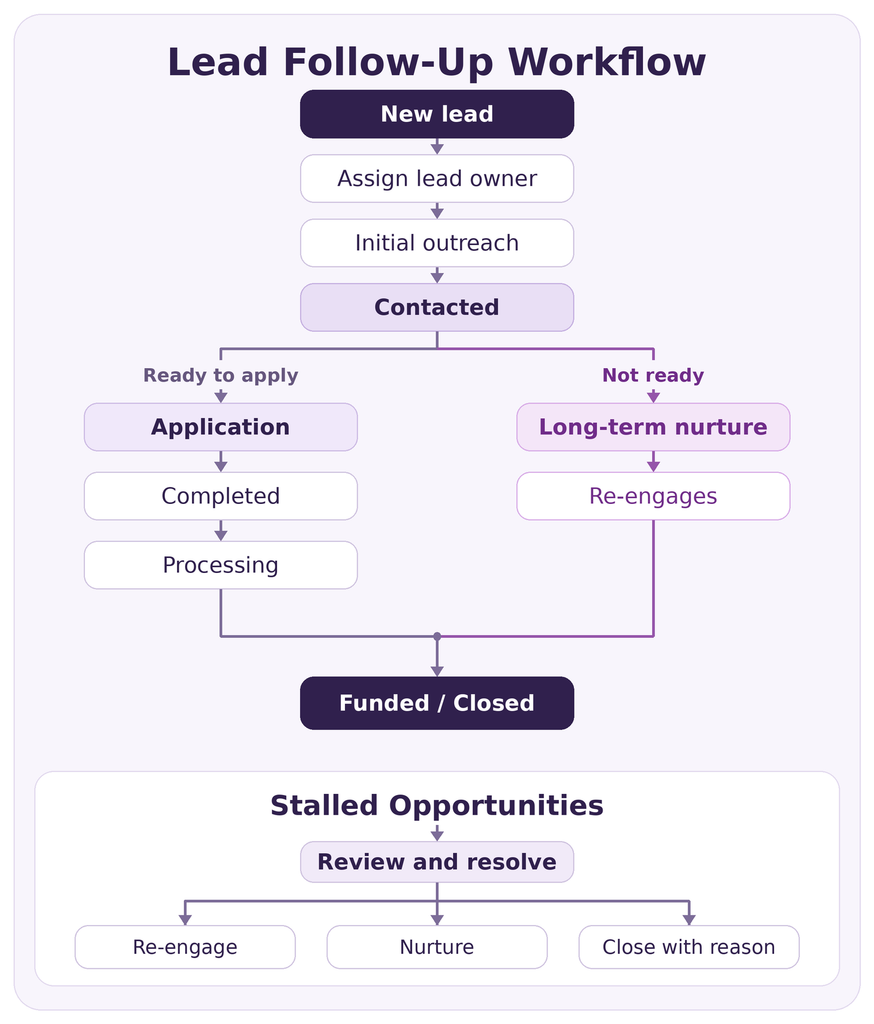
Diagram note: Stalled is an exception status that can occur during outreach or application. Funded and closed outcomes should be synchronized with the loan origination system.
Every stage needs:
- An entry rule
- A responsible owner
- A defined next action
For example, a prospect shouldn’t move into the contacted stage just because an automated email was delivered. That stage should represent meaningful two-way communication.
Likewise, an application shouldn’t be marked complete just because a borrower opened an application link.
Clear definitions make performance reporting more reliable across teams and branches.
Schedule a Discovery Session
Learn how to attract new leads and clients.
Where mortgage CRM automation helps and where loan officers take over
Mortgage CRM automation helps lenders maintain consistent workflows without requiring loan officers to manage every administrative step manually.
Its greatest value comes from reducing delays and preventing missed actions.
Automation can handle:
- Lead intake: Capture inquiry details, source attribution, and submission timestamps.
- Routing: Assign leads based on approved business rules.
- Notifications: Alert loan officers when new inquiries arrive.
- Reminders: Flag overdue tasks and upcoming follow-ups.
- Nurturing: Deliver approved educational content through permitted channels.
- Reporting: Track stage changes, activity, and conversion outcomes.
However, automation shouldn’t replace conversations that require experience, judgment, or trust.
When loan officers should take over
Loan officers provide the greatest value when borrowers need to:
- Discuss financing goals
- Compare appropriate products
- Clarify documentation
- Understand the application process
For example, automated messaging can help a first-time homebuyer schedule an appointment, but an experienced loan officer needs to explain loan options, answer questions, and determine the appropriate next steps.
Similarly, a borrower concerned about affordability needs a thoughtful conversation, not a sequence of generic reminders.
Make CRM automation compliant by design
Before activating automated mortgage follow-up, lenders must evaluate their outreach in accordance with applicable federal and state requirements.
These include:
- The Telephone Consumer Protection Act (TCPA) and applicable Federal Communications Commission (FCC) rules
- The Federal Trade Commission (FTC) Telemarketing Sales Rule, where applicable
- Federal and state Do Not Call requirements
- The CAN-SPAM Act
Your CRM should maintain appropriate records of consent, communication preferences, applicable restrictions, and opt-out requests.
The Eleventh Circuit vacated the FCC’s proposed one-to-one consent rule in January 2025. That decision did not eliminate other applicable consent requirements.
Lenders should have qualified compliance counsel review their contact practices, especially automated calls, texts, third-party leads, state-specific rules, and consent documentation.
Why 90–180-day mortgage lead nurturing can be valuable
Not every mortgage prospect is ready to make a decision within the first week. Some borrowers need time to save money, compare financing options, identify a property, or resolve questions about their finances.
A 90–180-day mortgage lead nurturing plan can help lenders stay connected with prospects who have longer purchase timelines.
A sample 180-day mortgage nurturing strategy
| Timing | Nurturing objective | Example content |
| Days 1–7 | Respond and establish the relationship | Personalized introduction and next-step resources |
| Days 8–30 | Answer initial financing questions | Preapproval preparation or mortgage process guide |
| Days 31–60 | Support borrower education | Loan program comparisons and affordability resources |
| Days 61–90 | Reassess financing interest | Personalized check-in or educational consultation |
| Days 91–180 | Maintain relevant engagement | Homebuying updates, preparation checklists, or requested resources |
This schedule is illustrative. Actual outreach frequency must respect borrower preferences, consent, suppression requirements, and applicable laws.
How to handle stalled opportunities
Long-term nurture and stalled opportunities aren’t interchangeable.
- A prospect who has clearly indicated a future purchase timeline belongs in a nurturing workflow.
- A borrower who started an application but stopped responding requires a different approach.
Loan officers should review what interrupted their progress, document the next appropriate action, and avoid repeated outreach when the borrower has declined contact.
If the borrower indicates they’re no longer interested, the CRM should reflect that decision and enforce the required suppression.
This approach also supports lender strategies for re-engaging prospects during changing market conditions, as discussed in our article on mortgage marketing in a high-rate market.
5 mortgage lead conversion metrics to review every week
A weekly loan officer scorecard can help managers identify operational issues before they become recurring production problems.
The following five metrics provide a useful foundation.
1. First response time
Calculation: Time of first qualifying response attempt minus lead submission time.
Track:
- Median response time
- The percentage meeting your internal target
- The number of inquiries receiving no response attempt
Separate business-hours and after-hours leads to make comparisons meaningful.
2. Contact rate
Calculation: Leads with meaningful two-way contact / eligible leads × 100.
This measures whether outreach is producing conversations.
A high number of outbound attempts doesn’t necessarily translate into a strong contact rate.
3. Application conversion rate
Calculation: Leads that start an application/leads contacted × 100.
This measures how effectively conversations advance borrowers into the application process.
For consistent reporting, distinguish application starts from completed applications.
4. Application completion rate
Calculation: Applications completed / applications started × 100.
Low completion rates may indicate the following:
- Unclear instructions
- Documentation barriers
- Borrower hesitation
- Problems with the application experience
Some solutions involve loan officer support, while others will require better digital workflows.
5. Funded-loan conversion rate
Calculation: Funded loans attributable to a lead cohort/leads in that cohort × 100.
This connects acquisition and follow-up performance to actual production.
Because mortgage loans take time to close, compare mature cohorts rather than only matching the current week’s funded loans with the current week’s leads.
Weekly loan officer scorecard
| Metric | Illustrative weekly result | Management question |
| Median first response time | 12 minutes | Where are response delays occurring? |
| Contact rate | 48% | Are outreach methods effective? |
| Contact-to-application rate | 30% | Are conversations advancing? |
| Application completion rate | 72% | What’s preventing borrowers from finishing? |
| Funded-loan conversion | 3% | Which lead cohorts produce loans? |
Sample data only. These are hypothetical values, not lender results or industry benchmarks.
Managers should review performance by lead source, loan officer, and borrower intent. While response times and contact rates can reveal recent operational problems, funded-loan conversion should be measured using older lead groups that have had sufficient time to close.
Avoid relying on rankings between individual loan officers without accounting for differences in lead source, borrower readiness, workload, and product mix.
How to improve mortgage lead conversion before buying more leads
Before increasing your lead generation budget, find out where existing prospects stop moving forward.
Are leads reaching the right loan officers? How many prospects receive a timely response? And how many eventually become funded loans?
A conversion audit can reveal whether a lender needs more inquiries or a better process for managing the opportunities already in the pipeline.
Step 1: Audit lead intake and ownership
Review a recent sample of inquiries across your main acquisition channels.
Identify:
- Duplicate records
- Unassigned leads
- Missing source attribution
- Delayed notifications
- Incorrect routing
Every inquiry should have a clear status and accountable owner.
Step 2: Examine response performance
Measure actual timestamps rather than relying on self-reported activity. Look for differences between business hours, weekends, branches, and lead sources.
Identify whether problems originate with CRM delivery, routing rules, staffing, or follow-up execution.
Step 3: Review stage definitions and automation
Determine whether the CRM accurately reflects borrower progress.
Check for opportunities remaining indefinitely in the new or contacted stages, automated sequences continuing after opt-outs, and tasks without owners.
Confirm that CRM stages align with application and funding information from your loan origination system.
Step 4: Evaluate mortgage lead nurturing
Identify prospects who expressed future financing interest but have no documented follow-up plan. Segment them by relevant needs and timing, then establish appropriate nurturing workflows.
Focus on providing value rather than increasing message volume.
Step 5: Connect conversion performance to marketing ROI
Calculate acquisition costs and funded-loan conversion by source.
Then evaluate whether improved follow-up could generate more production from existing spending.
Use contribution margin and operational capacity to determine whether conversion improvements justify additional CRM investment.
FAQs: Mortgage lead follow-up
Mortgage lenders benefit from responding promptly while the borrower’s inquiry is relevant.
Many teams use internal response-time targets measured in minutes, but no single target guarantees conversion.
Effective follow-up also requires proper routing, relevant messaging, sufficient team coverage, and compliance with applicable communication restrictions.
There is no universal number of follow-up attempts. Frequency should reflect borrower interest, communication preferences, permitted contact methods, and applicable laws.
Lenders need a documented approach that provides relevant information without excessive or unwanted outreach.
Mortgage CRM automation uses software to manage repetitive lead-conversion tasks, including assigning inquiries, notifying loan officers, scheduling reminders, recording activity, and delivering permitted nurture communications.
It supports consistent execution while allowing loan officers to handle personalized financing conversations.
A useful mortgage lead conversion rate depends on how the metric is defined, the acquisition channel, borrower readiness, loan product, and observation period.
Lenders should measure both intermediate conversion stages and the percentage of a mature lead cohort that results in funded loans.
Turn more of your existing mortgage leads into funded loans
Before committing more money to advertising or purchased leads, understand how effectively your current pipeline turns inquiries into applications and funded loans.
Kaleidico helps mortgage lenders identify conversion bottlenecks, improve CRM workflows, and align marketing investment with measurable lending outcomes.
Ready to get more value from the leads you’re already paying for? Request a Mortgage CRM and Lead Conversion Audit to identify where your follow-up process can be improved.